 When you’re trying to figure out where to go for eye care, the terminology can be confusing. Ophthalmologist, optometrist, eye doctor, eye specialist… Although these terms get used interchangeably, they don’t mean the same thing. The differences matter, because choosing the right type of eye care provider can affect how quickly you get the care you need and how seamlessly your eye health is managed over time.
At Overlake EyeCare, we offer both ophthalmology and optometry services at our Bellevue and Kirkland locations. This guide explains the differences between the two, when you might need each, and why having both under one roof can make your eye care experience simpler and more complete.
Key Takeaways
- Ophthalmologists are medical doctors (MDs) who can perform eye surgery and treat complex medical eye conditions.
- Optometrists are doctors of optometry (ODs) who provide comprehensive eye exams, vision correction, and management of many common eye conditions.
- Both ophthalmologists and optometrists can diagnose eye disease, prescribe medications, and provide routine eye care.
- For most patients, an optometrist handles routine eye care, with referrals to an ophthalmologist for surgery or advanced medical treatment.
- Practices that offer both ophthalmology and optometry under one roof can coordinate care seamlessly without outside referrals.
- Overlake EyeCare offers comprehensive ophthalmology and optometry services at our Bellevue and Kirkland offices.
1. Understanding the Difference
The clearest way to think about ophthalmology and optometry is by training and scope of practice. Both are doctors. Both are highly trained in eye health. But the paths they take and the work they do are different. Here is a visual of the amount of schooling needed to become an ophthalmologist vs. optometrist from Washington Academy of Eye Physicians and Surgeons (WAEPS):
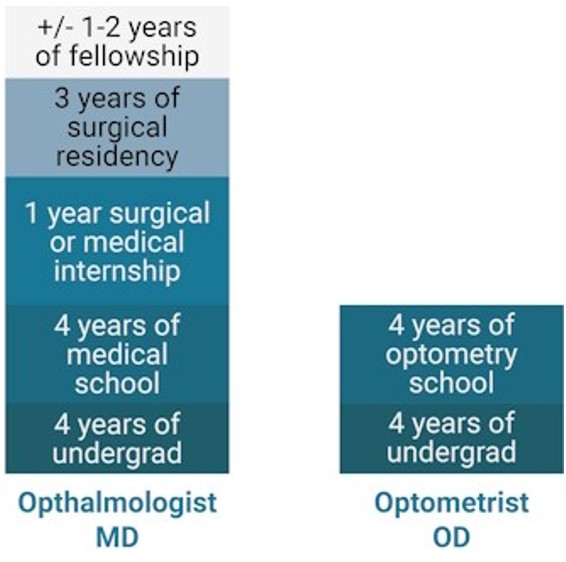
In short: optometrists handle most of what brings patients into an eye care office on a routine basis. Ophthalmologists handle surgery and complex medical care. Both work together in many practices to provide complete care.
2. What Each Provider Treats
The day-to-day work of an ophthalmologist and an optometrist can overlap in many areas, but each has services that are typically their domain.
Optometrists commonly handle:
- Comprehensive eye exams and vision testing
- Glasses and contact lens prescriptions
- Contact lens fittings for conditions such as monovision, astigmatism, or presbyopia
- Dry eye diagnosis and treatment
- Diabetic eye exams and ongoing monitoring
- Glaucoma screening and many cases of glaucoma management
- Myopia management for children and teens
- Treatment of eye infections, allergies, and minor injuries
- Pre- and post-operative care for surgical patients
Ophthalmologists commonly handle:
- Cataract surgery and intraocular lens implantation
- Refractive lens exchange surgery evaluations and procedures
- Advanced glaucoma surgery and laser treatments
- Diabetic retinopathy treatment, including injections and laser
- Macular degeneration treatment
- Eye trauma requiring surgical repair
- Complex or chronic medical eye disease
- LASIK screenings
The reality is that most patients benefit from working with both. Routine care, contact lens fittings, and ongoing condition management often live with the optometrist. Surgery and advanced medical treatments shift to the ophthalmologist when needed.
3. When to See an Optometrist
For most adults and children, an optometrist is the right first stop for eye care. You should schedule a visit with an appointment if:
- You’re due for a routine comprehensive eye exam
- You need an updated glasses or contact lens prescription
- You want to try contact lenses for the first time
- You’re experiencing dry, irritated, or red eyes
- You’ve been diagnosed with diabetes and need an annual eye exam
- You have a family history of glaucoma or other eye disease
- Your child needs an eye exam for school or sports
- You’re experiencing minor eye irritation, allergies, or mild infection
- You want a baseline evaluation before considering LASIK or cataract surgery
An optometrist will let you know if your situation calls for an ophthalmologist’s care and coordinate the referral when needed.
4. When to See an Ophthalmologist
An ophthalmologist’s training and surgical capability make him/her the right provider if:
- You need cataract surgery or are exploring premium lens options
- You’re considering LASIK or other refractive surgery
- You’ve been diagnosed with a serious or advancing eye disease
- Your glaucoma requires surgical or laser treatment
- You have diabetic retinopathy requiring injections, laser, or surgery
- You’ve experienced significant eye trauma
- You need a second opinion on a complex eye condition
- You’ve been referred by an optometrist for advanced evaluation or surgical care
In many cases, the easiest path is to see an optometrist first, who can determine whether ophthalmology care is needed and make the right referral if so.
5. Comparing Ophthalmology and Optometry
Side-by-side, the two roles look like this:
Ophthalmology vs. Optometry at a Glance
| Area | Optometrist (OD) | Ophthalmologist (MD) |
| Education | 4-year Doctor of Optometry program | 4-year Medical school + internship + residency |
| Eye exams | Yes, comprehensive | Yes, comprehensive |
| Glasses and contacts | Primary provider | Less common in their role |
| Eye disease diagnosis | Yes | Yes |
| Prescription medications | Yes | Yes |
| Eye surgery | No major surgery (some minor procedures such as LAL post-op appointments) | Yes, full surgical scope |
| Refractive lens exchange (RLE) surgery | Pre- and post-op care | Performs the procedure |
| Cataract surgery | Co-management before and after | Performs the procedure |
| Best first stop for | Routine care, vision correction, most eye concerns | Surgical care, advanced disease, complex cases |
Your eye doctor will help you understand which provider matches your specific needs at any given time. In a practice that offers both, those handoffs happen seamlessly within the same care team.
6. Ophthalmology and Optometry at Overlake EyeCare (Bellevue and Kirkland)
Our Bellevue and Kirkland offices provide both ophthalmology and optometry services under one roof, so patients can receive the full spectrum of eye care without bouncing between practices. What sets us apart:
MDs and ODs on site: Our board-certified ophthalmologists and doctors of optometry work side by side, so you get the right level of care for whatever you’re dealing with.
Seamless coordination: When a patient needs to move between routine care and surgical or advanced medical care, the transition happens within the same practice, with shared records and a consistent care plan.
In-office procedures: Many treatments that would otherwise require a separate referral, such as MIBO Thermoflo, are handled in Overlake Eyecare’s Bellevue office.
Complete care under one roof: From comprehensive eye exams and contact lens fittings to cataract surgery, glaucoma management, and dry eye treatment, our team handles the full range of eye care needs.
Two convenient locations: Our Bellevue and Kirkland offices offer comprehensive services, so patients can choose the location that works best for their schedule.
Convenient access: Easy access for patients in Bellevue, Kirkland, Redmond, Bothell, Woodinville, and surrounding communities.
Frequently Asked Questions
Is an optometrist a real doctor?
Yes. An optometrist is a doctor of optometry (OD) who has completed four years of post-graduate training in eye health, vision, and ocular disease. They are licensed to diagnose eye disease, prescribe medications, and treat many common eye conditions.
Should I see an ophthalmologist or an optometrist first?
For routine eye care, vision concerns, or most common eye conditions, an optometrist is the right first stop. If you have a surgical need, advanced eye disease, or a complex case, an ophthalmologist may be more appropriate. In a practice with both, your eye doctor can make the right call from your first visit.
Can an optometrist treat eye disease?
Yes. Optometrists in Washington State can diagnose and treat many eye diseases, including glaucoma, dry eye, eye infections, and diabetic eye disease. They refer to an ophthalmologist when surgery or advanced medical treatment is needed.
Why does Overlake EyeCare have both ophthalmologists and optometrists? Having both under one roof means our patients get the right level of care without needing outside referrals. Routine care, surgical care, and ongoing management all happen within the same practice, with the same team and shared records.
Will my insurance cover both ophthalmology and optometry?
Medical insurance often covers care related to specific health conditions, surgical procedures, and treatment of eye disease. Vision insurance coverage varies whether the doctor is contracted with the specified program. Our staff can help you understand your specific coverage before your visit.
What’s the difference between an optician, an optometrist, and an ophthalmologist? An optician fits and dispenses glasses and contacts but does not perform eye exams. An optometrist performs comprehensive eye exams and provides medical eye care without major surgery. An ophthalmologist is a medical doctor who can perform eye surgery and treat the full range of eye disease.
Can I switch between providers within Overlake EyeCare?
Yes. Many of our patients see different providers within our practice for different needs, routine exams with one of our optometrists, surgical care with one of our ophthalmologists. All providers have access to your full record, so care stays consistent.
Conclusion: One Practice, Complete Eye Care
Choosing between an ophthalmologist and an optometrist doesn’t have to be complicated. In most cases, you don’t have to choose at all: you just need a practice with both. The right combination of ophthalmology and optometry, working together, gives you routine care, advanced medical care, and surgical care without the hassle of moving between practices.
At Overlake EyeCare, we’ve been serving the Bellevue and Kirkland communities for over 40 years. Contact us today to schedule an appointment at our Bellevue or Kirkland office, and experience what comprehensive, coordinated eye care under one roof feels like: 425-643-2020.